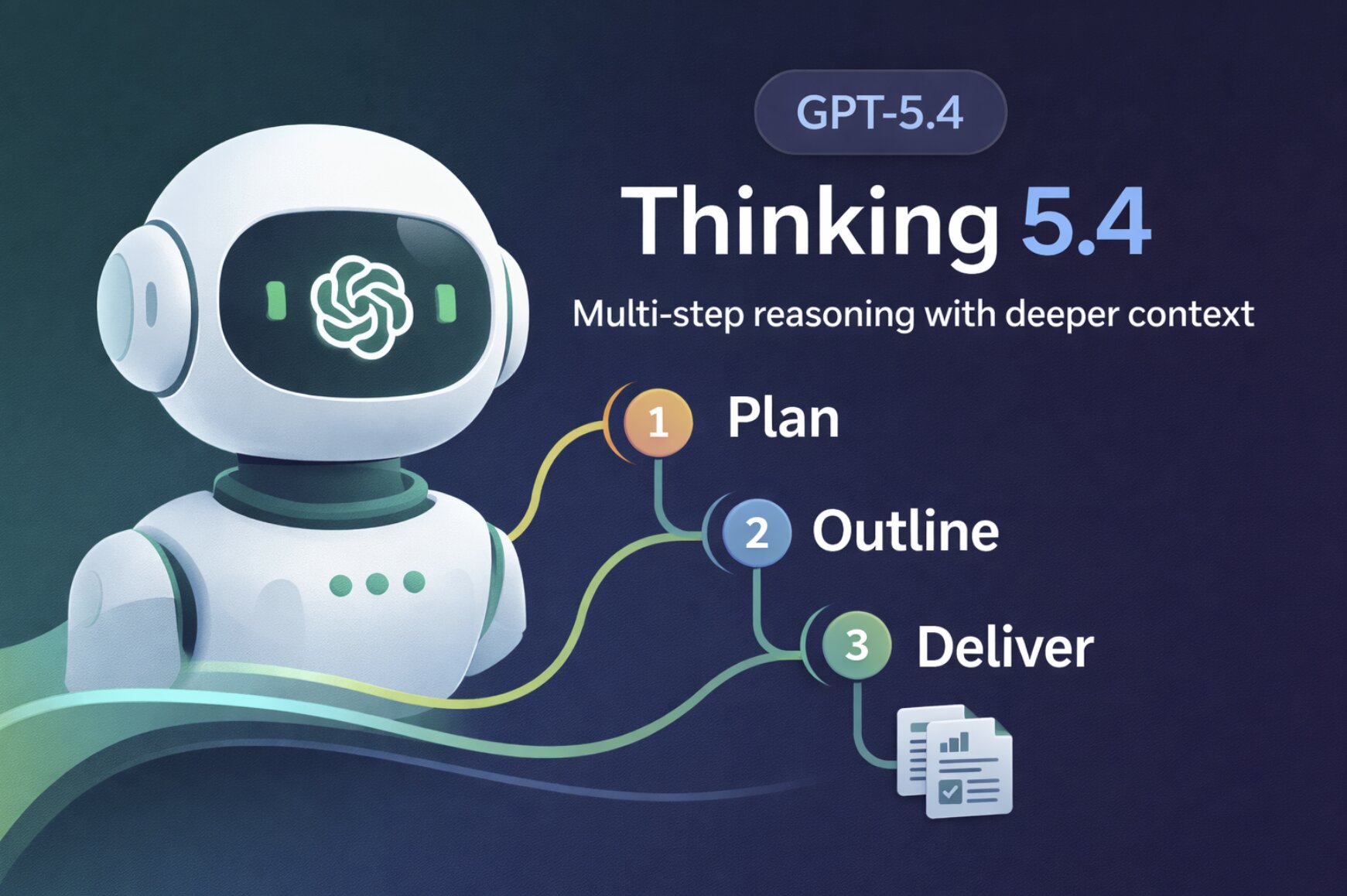
If you’ve been using ChatGPT mainly for quick answers, Thinking 5.4 (GPT-5.4 Thinking) is the mode you switch to when you need the model to do real multi-step work.
What I’m noticing with GPT-5.4 Thinking is that it’s built to reduce the “back-and-forth” problem. It can show an upfront plan/preamble, so you can steer it while it’s working instead of fixing everything after the first draft. It also holds context better for long tasks and is stronger for document-heavy work and deep web research.
What feels different (practically)
• Longer thinking without timing out, and it tracks what it has already done more reliably. Kurang “ulang-ulang” details.
• Cleaner outputs: less unnecessary headers, more streamlined structure.
• Designed to be stronger across “work outputs” like documents, spreadsheets, and presentations, not just chat.
How I would use for higher ed:
1) Assessment redesign for the AI era
Use Thinking 5.4 to produce an “AI-resilient” brief: process evidence, rubric descriptors, micro-viva prompts, and marking guidance. The value is the structured reasoning and consistency, not fancy wording.
2) Literature synthesis that doesn’t collapse into fluff
When you need a matrix (themes, gaps, contradictions, methods), Thinking 5.4 is better suited to hold many moving parts and maintain a coherent structure over longer outputs.
3) Tutorial-building from dense readings
Upload a reading, then generate: misconceptions, mixed-difficulty questions, a mini-case, and a 20-minute activity plan. Thinking mode tends to stay on-task with fewer random detours.
Simple rule (senang cerita)
► Instant (5.3) for fast daily Q&A.
► Thinking 5.4 when you want a deliverable: structured plan, multi-step reasoning, long documents, or research that needs careful context.